To register, we prefer you pay online via the black "REGISTER" button. But you may mail a coupon and a check by snail mail.
Click here for the speakers and tentative scheduling
To be part of the PBKNCA package, do not reserve directly with the facility. Wait for the email message from Barry (probably in October). Be sure you check your email, or you may find you don't have a room. For registration or logistics matters, please contact Barry Haskell at bghaskell@comcast.net. More egistration info is here
Our speaker roster is complete, and is shaping up as a really extraordinary program. As always, we include speakers from across the arts and sciences – technology, politics, astrophysics, geography, law, the arts, and modern language and culture. There will be something for everyone! The speakers and tentative scheduling are in the following table. Below the table are bios of the speakers and summaries of the topics. Click on either the Speaker name or event Title to go for more information
|
DAY / TIME
|
SPEAKER
|
DISCIPLINE / TOPIC
|
TITLE |
|
Fri eve
|
Andrew Reddie, (Teaching Excellence awardee)
|
Technology, public policy and global security
|
From Innovation to Instability: Emerging Technologies and International Security
|
|
Sat am
|
David Sandino
|
CA water rights + the law
(SCU Law)
|
An Inside View of the Klamath Dam Removal Project: The Largest Environmental Restoration Project in American History
|
| Sat aft |
Gil-li Vardi (Teaching Excellence awardee) |
Modern military history, wars and society (Stanford) |
Is Conventional War Back? The Present and Future of war |
| Sat eve |
Nancy Abrams |
B.A 1969 with General Honors, University of Chicago, and J.D. 1973 University of Michigan
“Philosophical Cabaret”
|
Science As Spiritual Power |
| Sun am |
James Glaser |
Provost of Santa Clara University (PBK) |
Everyday Democracy: Liberals, Conservatives, and Their Attitudes About Politics |
| Sun aft |
Joshua Landy (Teaching Excellence awardee) |
French literature and culture (Stanford) |
Marcel Proust and the Re-Enchanted World |
|
Sun eve
|
Alejandra Rosselli-Calderon (Scholarship Awardee) |
Astrophysics (UCSC, PBK)
|
A Stellar Perspective of History |
|
Mon am
|
Alexis Wood (Scholarship Awardee)
|
Geography (UC Berkeley, PBK) climate change, and rural socio-political movements State of Jefferson
|
Geography in Constellation |

Nancy Abrams, B.A 1969 with General Honors, University of Chicago, and J.D. 1973 University of Michigan. A philosopher of science, lawyer, and former lecturer on Cosmology and Culture at U.C. Santa Cruz.
“Philosophical Cabaret”
Science As Spiritual Power
Author of A God That Could Be Real: Spirituality, Science, and the Future of Our Planet, winner of the 2015 USA Best Book Award in philosophy. Nancy is also a singer/songwriter; her recent songs are on Substack at “The Philosophical Cabaret.”
Science As Spiritual Power
“The best lack all conviction, while the worst/Are full of passionate intensity.” (Yeats) Why? Can “the best” change this? It is no coincidence that the worst tend to be the most extreme, in all religions. Yet, so many wonderful people dedicated to saving the planet lack any sense of connection to the larger universe because they have no language or story that meaningfully narrates the experience of being an earthling in the real universe. Modern cosmology could be key to that story, providing in this dangerous era a new, responsible source of spiritual power.
 James Glaser, Ph.D., PBK; Provost and Prof. of Political Science, Santa Clara University
Everyday Democracy: Liberals, Conservatives, and Their Attitudes About Politics
Liberals and conservatives seem to have vastly different opinions about various policies. But do we actually think differently about politics -- concepts like civility, dialogue, compromise, power, and volunteerism? I propose that we do. In this talk, I will present some of these differences and offer an explanation of their origins -- and offer some thoughts about what to make of these differences and how they shed light on our current political environment.

Joshua Landy, Prof. of French and Comparative Literature, Stanford University; Co-director or the Initiative in Philosophy and Literature and co-host of the nationally syndicated public radio program “Philosophy Talk’.
“Marcel Proust and the Re-Enchanted World”
What can we do when the world loses its wonder for us? How can we find, again, the enchantment that we’ve lost? And what has art got to do with any of that? These are some of the big questions Marcel Proust was thinking about when he wrote his twentieth-century masterpiece, In Search of Lost Time. This lecture will explore Proust’s inspiring answers, as well as the re-enchanting delights in store for those of us lucky souls who get to read him.

Alejandra Rosselli-Calderon, Ph. D. Cand. U.C. Santa Cruz, Astrophysics; PBK Scholarship Awardee
A Stellar Perspective of History
The history of humanity is deeply intertwined with the cosmos. From the earliest settlement that developed agriculture to long voyages across the seas. The history generally taught in school focuses only on the sky as the Greeks saw it, but our ancestors have looked at the sky from every corner of the world for hundreds of thousands of years. In my talk I hope to bring to you just a small look at the cosmos from our very own small speck of a planet.
A Colombian scholar, at UCSC Rosselli-Calderon has had the remarkable opportunity to advance our understanding of how stars and black holes dance together in the depths of space.
Andrew Reddie, (Teaching Excellence awardee) 
faculty at the U.C. Berkeley’s Goldman School of Public Policy, and Founder / Director of the Berkeley Risk and Security Lab.
From Innovation to Instability: Emerging Technologies and International Security Cybersecurity
Debates about emerging technology and international security often gravitate toward distant and speculative futures -- yet many of the most consequential risks are already taking shape today, through artificial intelligence, advanced intelligence, surveillance, and reconnaissance systems, and missile defenses (e.g., the Golden Dome. This talk examines the near-term implications of these developments for nuclear deterrence and escalation. It argues that the central policy challenge is not simply controlling technological capability, but understanding how new systems reshape decision-making under conditions of acute uncertainty.

Davis Sandino, Ll.D., Water resource expert, and Professor of Law at Santa Clara University
An Inside View of the Klamath Dam Removal Project: The Largest Environmental Restoration Project in American History
The Klamath River was one of the largest salmon fisheries on the West Coast. However, during the last 100 years, migratory salmon were blocked from a large part of the watershed by a series of hydroelectric dams. Now, through the collaborative efforts of the Yurok Tribe, the Karuk Tribe, California, Oregon, the Klamath River Renewal Corporation, and PacifiCorp, four dams were removed in 2024, which opened up a large part of the watershed to assist in salmon recovery. This presentation will explain the story behind the dam removal project and the status of efforts to restore the watershed.
 Gil-li Vardi (Teaching Excellence awardee), Ph.D., Faculty in the Dept. of History and the Program in International Relations, specializing in modern military history (PBK Teaching Excellence awardee)
Is Conventional War Back? The Present and Future of war
The data is clear - for decades, conventional war was in decline. So, is it making a comeback now? And, if we are experiencing a resurgence, what can current conflicts reveal about the character of war today and in the foreseeable future? What - if anything - sets contemporary war apart? What is the meaning of victory (and defeat)? While we cannot predict the future, this talk employs historical analysis and historical thinking to attempt to make sense of the current state of war.
 Alexis Wood (UC Berkeley, (PBK Norall Scholarship Awardee ) Ph.D. Cand., Geography, U.C. Berkeley
A Geography in Constellation
What does it mean to know a place? To trace its borders? To inherit its histories and archives or to move through its landscapes? Listen to its stories? Or to confront the stories we make as we experience it?
This talk takes Northern California and the recurring State of Jefferson secessionist movement as a way into this broader problem. Jefferson presents an unusual geographical object: a region repeatedly named and mapped but never formally constituted; invoked across different historical moments but without stable boundaries, membership, or meaning. I approach the region as a constellation of encounters, landscapes, histories, infrastructures, stories, and political imaginaries whose relations become visible from particular positions and moments. What can partial, situated, and sometimes contradictory forms of knowledge reveal about how regions come into being? And what might the constellation offer as a way of knowing places whose coherence lies precisely in the relations among their fragments?

Registration, which goes in part to scholarships, is $150 (member and their guests rate), $180 Non-PBKNCA.
Asilomar cost in 2026 was $680/person, double occupancy. Including room, all meals and parking. Of course, it will be a little more in 2027!
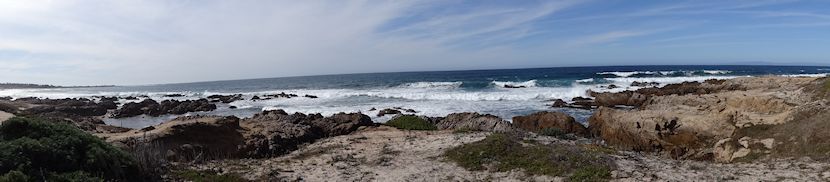
As we look forward to a year likely filled with surprises throughout our world, PBKNCA members are again preparing for an inspiring February weekend to recharge our engines, gain some new perspectives, and connect with friends from across California, both new and old. So, come relax with friends in a historic state park and coastal retreat. Recharge your batteries on the lovely Monterey coast. Venture onto horizons you’ve perhaps not considered – or even thought of – before.
Our speaker roster is complete, and is shaping up as a really extraordinary program. As always, we include speakers from across the arts and sciences – technology, politics, astrophysics, geography, law, the arts, and modern language and culture. There will be something for everyone!
Please mark your calendar now for a remarkable weekend along the Asilomar coast February 12 - 15, 2027, Better yet, send your registration today to reserve a place, and ensure we retain best pricing for our annual gathering .
If you have questions on this year’s program, outlined below, please contact dfrontczak@scu.edu. For registration or logistics, please contact Barry Haskell at bghaskell@comcast.net. Registration is $150, which goes toward scholarships for our graduate students. Costs will be similar to last year, about $680 per person, double occupancy, and includes all nine meals and parking. All registered participants will receive a link to reserve their Asilomar accommodations, including meals; please check your email. (Remember, to be part of the PBKNCA package, do not reserve directly with the facility.)

“Education is the most powerful weapon we have to change the world.” – Nelson Mandela
Some of you may feel ready for new beginnings. Some may be eager to expand your learning into unexplored ground. Some of you may just be eager for a chance to hang with friends in a beautiful, refreshing and historic coastal retreat. And for some of you, all three apply. Thankfully, we are looking forward to a new season for the PBKNCA Asilomar Conference in February! It is again time to reserve your space for a weekend of learning, inspiration, fellowship and a breath of sanity, on the magnificent Monterey coast. Come, bring a friend, and find out for yourself.
If you have questions on this year’s program, please contact dfrontczak@scu.edu. For registration or logistics matters, please contact Barry Haskell at bghaskell@comcast.net. Registration is $150, which goes mainly to scholarships. Cost will be similar to last year, about $680 per person, double occupancy, and includes all nine meals and parking. All registered participants will receive forms to reserve their Asilomar accommodations, including meals; please check your email. (Remember, to be part of the PBKNCA package, do not reserve directly with the facility.)
Please join us once again for the annual Asilomar Conference -- to learn, engage in discussions, and to listen to one another in new ways.